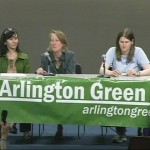
Arlington Greens Urge Improvements to Proposed Community Energy Plan on April 26

Arlington Greens Urge Improvements to the Proposed Community Energy Plan at the County Board hearing, April 26, 2011
Good evening. My name is Stephen Davis, and I have lived in Arlington County for 33 years. I’m here tonight on behalf of the Arlington Green Party to address the Community Energy Plan contemplated in Consent Item 26.
The Arlington Green Party has been monitoring the development of the Community Energy Plan with great interest, and we believe that the County government should be commended for initiating this effort,
As a general matter, with the exception of developing a District Energy model, the Task Force report seems to regard the County government’s roles primarily as citizen/business energy education, moral suasion, and serving as a resource for individuals and businesses in implementing the actions recommended in the final Report. We agree with these policies, but we also believe that the County government should more aggressively seek ways to provide direct financial incentives, that the County should place greater emphasis on raising environmental and energy consciousness in Arlington’s public schools, and
that the County should more actively advocate with state and federal officials for those policies which will assist it reaching its Community Energy Plan goals.
In general, we agree in principle with most of the Task Force recommendations, but there are a few exceptions. Specifically I would refer you to the comments we submitted to the draft report and which are found on the County’s website.
Tonight I would like to address one of the larger concerns we have with the proposed Community Energy Plan. This is the District Energy model.
Clearly, the District Energy model provides significant benefits for higher density developed areas, such as greatly improved efficiency, better security and a smaller GHG footprint. In our view, the establishment of District Energy entities is the key to the Community Energy Plan.
Nonetheless, implementation of an Arlington District Energy model remains unclear at best due to the Dillon Rule legal doctrine. Thus, to create a District Energy entity, Arlington would have to seek and obtain authority from the Commonwealth.
The question of the legal sufficiency of the District Energy model was raised several times during the Task Force meetings, but each time the response was that the issue was “being explored.” In our view, until this issue is resolved, the likelihood of successful implementation of the Community Energy Plan is in doubt.
Linked to the establishment of the District Energy model is the recommendation to create a mixed-use, net-zero energy scale project. This recommendation is critical to demonstrate the viability of the District Energy concept, and the District Energy model is critical to the success of the scale project. However, if the District Energy idea itself is not feasible, then this scale project recommendation becomes moot.
As I noted previously, we support most of the proposals outlined in the Report, although we believe that some could have gone further, but until the legal issues inherent in the District Energy model are resolved, we do not believe that the proposed Community Energy Plan can move forward.